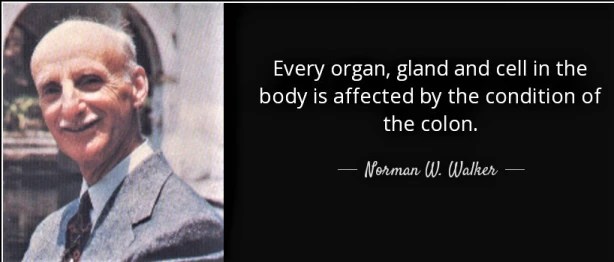
When I read Dr Norman Walker’s Diet and Salad and Colon Health in 1980, I had married and started a new life in Sydney. I also wanted an answer to my chronic gastritis. The person who gave me the books thought they would help fix my problem – but judging by the titles, I was sceptical …

No-one I knew in Singapore ever went on “a diet”: our “salads” were only a few slices of tomato and cucumber, topped with coriander and chillies. Granny Azizah’s zesty tzalata (diced cucumber, tomato, parsley, onion and lemon juice) was made to “cool down” the spicy food we were eating.
Did Colon Health really have “the key to a vibrant life” as stated in the sub-title? I flicked through the pages and saw this:
“The kind and the quality of the food you put into your body is of vital importance to every phase of your existence.”
Walker, N.W. (1979). Colon Health: The key to a vibrant life, p.3. O’Sullivan Woodside & Co: Phoenix, Arizona.
Strange, and contrary to what I was taught. I remember asking Mum why “Uncle” or “Aunty” was sick in hospital; she said, “They’re just getting old!” And at age 9, I firmly believed it and dreaded what was ahead of me.
Colon Health opened my eyes – and so did Diet and Salad, which I promptly read soon after. Dr Walker’s theory on the cause of “acid stomach” was quickly labelled “rubbish” when I told my family about it …
Nevertheless, I put his theory in practice. I didn’t have fruits or dessert after meals, and drank a large tumbler of water with lemon juice and freshly squeezed citrus first thing in the morning. With my antacids close at hand, there was now no sign of acidity – my gastritis was gone in less than a week and my life had changed forever!
I began my mission to learn everything I could to keep myself and my family healthy – reading books on the digestive system, human anatomy and supplements. I collected news articles, medical reports, tore pages off magazines, had a notebook on the kitchen counter ready to take down anything I heard on radio and TV about health or advances in medicine.
Working in the health system as a payroll officer opened up another valuable source: PEOPLE. From medical and nursing staff to clinical support and catering, I engaged with many hundreds over 40 years. Cultures and traditions were diverse, but there was one common thread: the love of food, and worries about weight and health.
What have we done since then, and what’s now happening to our health??
We have several diet programs, take loads of supplements, waste money on pulverisers that destroy life-giving raw vegetables and fruit into liquid laxatives. We’re still bloated, overweight and constipated, frequently catch colds, and – saddest of all – get treated for chronic and immune system diseases some of which we’ve never heard of.
A welcome discovery came in 2020: the publishing of David Raubenheimer and Stephen Simpson’s Eat Like The Animals and Luigi Fontana’s The Path to Longevity. They explained the importance and value of fibre and plant compounds – phytonutrients, phytochemicals and polyphenols – abundant in fresh vegetables and fruit. Our choice? Convenient, fast food from takeaway counters and supermarket freezer shelves, and highly processed long-life products from a variety of outlets.
And in 2023, SBS Australia screened The Invisible Extinction: a brilliant documentary narrated by Professor of Medicine and Biology Marty Blasser, and Microbiologist Gloria Dominguez-Bello.
In the beginning of the film, Dominguez-Bello says:
“I study microbes – the tiny organisms that live inside us. People hate germs – another word for microbes – but all life evolve from them and most are actually good for us. We call the ones living inside us our ‘microbiome’: a collection of bacteria, viruses and fungi. They are involved in almost everything our bodies do.
Microbes help us digest food and make vitamins. They train the immune system to protect us against invaders. They also determine to some extent our response to pain and our mood. These discoveries have started a scientific revolution. But just as we are learning how important they are our microbes are disappearing.”
Dominguez-Bello also mentions the value of poop and how its “trillions of tiny organisms … may help us find the answers to some of the biggest health problems.” There’s much in waste, evidently.
I encourage you to watch The Invisible Extinction. It runs for an hour and 22 minutes – compelling viewing from start to finish!
 Welcome to Shirl's Pearls: My Guide to a Good Life!