
It dawned on me flicking through media channels and seeing endless cook-shows – fab dishes and desserts we can’t resist … mesmerised to the end, when the chef digs in with “Mmm, it’s sooo good” – that something important was missed: the humble SALAD. It always starts my meal. Chefs seem to ignore this very foundation of nutrition; very few ads promote it, so perhaps there’s no money to be made here!
Adam Liaw, one of my favourite chefs and food writers (and an ex-Singaporean), recently observed:
“Prepared meals and delivery services are multi-billion dollar industries whose very existence relies on convincing people that they don’t have time to cook and you are stuck with either expensive and often unhealthy foods.”
(Sunday Life Magazine, Sydney Morning Herald, 26 May 2024)
We crave convenience – forget home cooking and unnecessary kitchen-time. Why prepare a salad? Simply fill your fridge with microwavable meals and the pantry with boxes of liquid breakfasts. Have a piece of fruit during the day and an occasional veggie juice from a colourful juice bar. We’re keeping healthy, aren’t we??
Here’s a drawing made by Dr Norman Walker of a diseased colon from an earlier post:
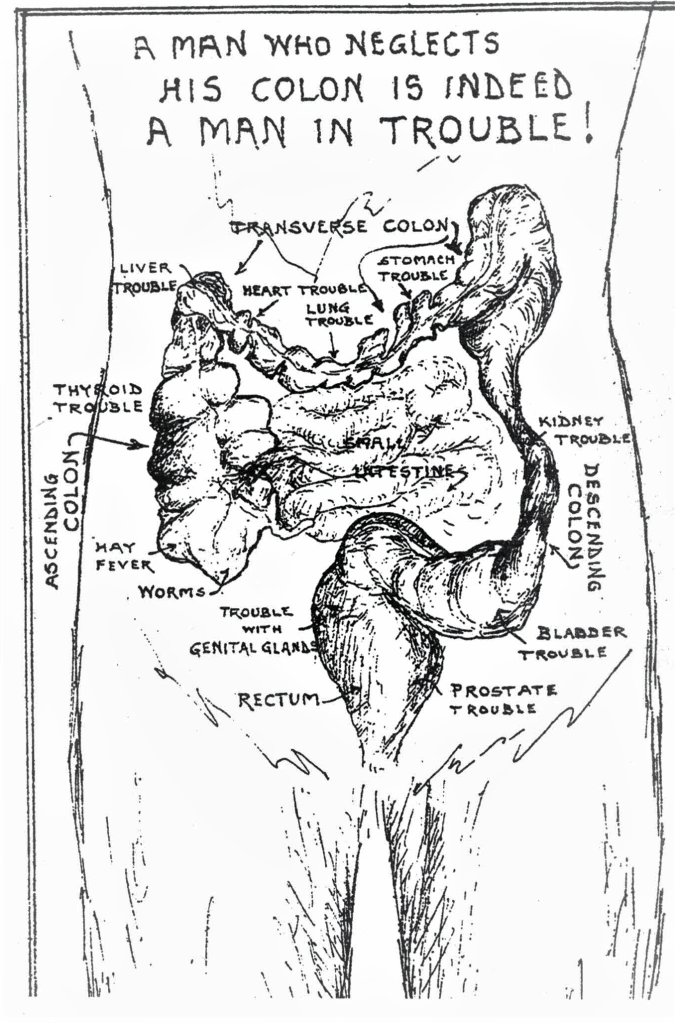
“If the body is permitted to degenerate, then the intellect cannot be expected to function or develop constructively.”
(Walker, Diet & Salad, p.26.)
The body and our mind?
The world recently lost beloved TV doctor and tireless healthy-life campaigner Michael Mosley. He wrote in 2017:
” … buried in our intestines is a very thin layer of brain. It is called the enteric system and is made up of the same cells, neurons that are found in the brain … so when we talk about ‘gut feelings’ we are reflecting the reality of how closely our guts and our brains are entwined.”
(‘The Clever Guts Diet’, Weekend Australian Magazine.)
What about the body itself? How can we prevent it degenerating? Do we have to accept “old age”, “bad genes” or “I love my food” excuses? And if our health is determined by the condition of our colon, how do we bring it back to life?
We should substitute ‘colon’ (unsexy today) for the gut and microbiomes: you need to feed them with phytonutrients, phytochemicals and polyphenols. Nutrient-rich compounds and chemicals are found only in plants and should be eaten raw in a salad. Most life-giving enzymes in fruits and vegetables are destroyed when cooked, canned or bottled. Aren’t there pills with rich plant compounds? Maybe, but your gut would much prefer dark green lettuce leaves!
” … A high vegetable intake, especially raw vegetables is associated with a lower risk of death from ischemic heart diseases, stroke, chronic respiratory disease, liver disease and some types of cancer.”
(Fontana, L. (2020). ‘The path to longevity: How to reach 100 with the health and stamina of a 40-year-old‘, p.95. Hardie Grant Books: Richmond, Victoria.)
Such foods are life-giving. Their nutrients are distributed into our blood through the villi in the small intestine, which sends to the large intestine anything it doesn’t need. The large intestine then excretes the waste in the form of stools. Without the necessary fibre provided by raw vegetables, the colon is starved of its function to nourish nerves, muscles, cells and tissues within its walls. Waste stays impacted, and constipation and bloating will result; fatigue, brain fog and loss of concentration will likely follow suit. Watch The Invisible Extinction – a brilliant documentary on gut microbiomes if you have an hour to spare.
According to data from the Australian Institute of Health & Welfare, only 10% of Australians eat the required daily amount of fresh fruit and veg. I suspect it’s much the same elsewhere. Don’t be among them.
- Start – with a an evening salad at least 30 minutes before dinner, preferably on an empty stomach. It gets to work for you much quicker this way and keeps you full.
- Pick 3 to 4 salad veggies, e.g. Cos (i.e. Romaine) lettuce – their dark green leaves are thicker and much richer in fibre than the round Iceberg. (If you find the Cos leaves harder to digest, cut them finely and chew well.)
- Carrots – they have almost all the vitamins and minerals our body needs
- Celery – rich in natural sodium, crunchy and refreshing. Chop the leaves finely and use them in soups, stews and as a garnish
- Cucumbers – high in silicone
- Capsicums – yellow is best as an antioxidant. (Red and green come next; green is harder to digest.)
- Fennel – extra-rich in fibre, refreshing to taste, and a good diuretic, laxative properties
- Beetroot – a dessert spoon grated raw is all you need!
- Herbs – any variety. They add flavour, aroma and colour, and have antimicrobial and antiviral properties
- Tomatoes – rich in lycopene, which may prevent prostate cancer
- Garnish – with herbs, apple slices, drops of lemon or orange juice instead of oil and vinegar; they’ll revive your tastebuds and bring life and taste to your salads! (Especially avoid mayonnaise for its unhealthy fats, sugars and salt.)
And do this too:
- Drink fresh clean water, ideally 2 litres a day
- Keep pre-meal fibre preps handy in the fridge – e.g. apples, carrots, fennel and celery; they’re great if you’re in a hurry or going out for dinner
- Exercise! Fitness gets your fibre moving (physical inactivity is the scourge of our times)
- Walk, dance, or swim 30 minutes a day at least
- Lift weights – incorporate as many structured exercise sessions as possible.
 Welcome to Shirl's Pearls: My Guide to a Good Life!