
I was deciding on our next post when the answer came from one of our social media followers: “Shirley, how do you get rid of belly fat??” When I lived in Singapore, people would put down a fat stomach to being full of “wind” – and right up to the ’80s, we’d take pills and powders for flatulence, bloating, indigestion and constipation. Not once did I hear it described as ‘fat’ – nor a hint that a person with a large belly should (God forbid) should go on a diet. Men got away scot-free; their big tummies were simply a sign of ‘prosperity’ …
I remember the days when it was considered healthy to fill up your plate. Not going for seconds made some think you were ill!
Many women notice an increase in belly fat as they get older, likely due to a lower level of oestrogen; I noticed this with my female work colleagues who were going through menopause in their mid-50s. Their weight gain was obvious, but they were sadly unaware that one of the causes was a drop in their hormone levels.
This was in the early 2000’s when menopause was still not talked about, and women were left to figure out what to do about it. Notably, older men are especially susceptible to carrying extra weight between the chest and hips – those beer-bellies we’ve all seen.
By that time, I had already been on HRT for over 15 years. Together with a good diet and exercise, oestrogen made it easier for me to control my weight. My endocrinologist suggested taking low-dose testosterone with my HRT. It was remarkable how much energy it gave me – but it also increased my appetite. I so loved dessert. After a rice-laden meal, I’d discreetly unzip my jeans to make room for a cake I’d bought at the local bakery. Eventually, my size 8 jeans had to be upsized to a 12. Panic set in … size 12 would soon become uncomfortable … would 14 be next??
No more, I said. It took a year of unyielding resistance and the bewilderment of my friends to flatly refuse dessert after meals. Giula Enders’ book Gut has an interesting chapter on sugar:
“ … we know them as the carbohydrates we find in bread, pasta or rice … the final product is the same number of sugar molecules as a couple of spoonfuls of refined household sugar … the only difference is that household sugar is already broken down into such small pieces when it arrives in the small intestine that it can be absorbed directly into the bloodstream. ...
“Sugar is the only substance our body can turn into fat with little effort.”
Enders, G. (2015). Gut, pp.48 & 50. Greystone Books Ltd: British Columbia, Canada.
During COVID, we frequented confectionery aisles, buying muffins, croissants, and cakes, and trawled through social media recipes just for that sugar hit to see us through lockdown. And of course, there was wine with dinner. Please remember that all this sugar, including soft drinks, wine, snacks and processed foods – even the so-called ‘zero sugars’ in stevia and aspartame – cause belly fat. It’s no wonder that many emerged with larger waistlines post-pandemic. Having lost motivation, many of us didn’t go on 15-day quick-loss diets or pound treadmills.
I disciplined myself to maintain my walking regime, returned to the gym, reduced my rice portions and took a sentence from Dr Walker’s wise words:
“ … if refined sugar of any kind whatsoever, or any flour product in any form is eaten during the same meal with fruits (except bananas, dates, figs or raisins) either together or within an hour or two, the sugars and starches will have a tendency to ferment … ”
Walker, N.W. (1940/1970). Diet & Salad, p.25. Norwalk Press: Summertown, Tennessee.
Peta Bee (December 6, 2023, The Australian) reported on a finding by Sydney’s Garvan Institute that a combination of calorie-dense comfort foods actually trigger changes in the brain that increase cravings for even more sweet and fatty foods. Our brains have now been programmed to crave calories in the form of fat and sugar. So let’s change the tape!
Author of the 1990s, Judith Wills, provides a list of ‘positive’ and ‘neutral’ foods:
Positive/Neutral foods
- Rolled oats, whole grain bread and honey to sweeten
- Salad vegetables and herbs (no dressing): celery, lettuce, fennel, parsley, basil, mint
- All fruits especially citrus (I suggest you have fruits on an empty stomach 30 minutes before food)
- Animal protein: eggs, cheese, yoghurt, oily fish, lean beef, veal, all poultry
- Plant protein: tofu, peanut butter, lentils, beans, nuts (e.g. sunflower seeds, walnuts, almonds).
Negative foods
- Cornflakes, white bread and white rice
- Sweet biscuits and cakes (particularly sponges)
- Soft drinks and high-salt foods (e.g. processed meats and cheese slices, tinned and packaged soups)
- Anything labelled ‘ready to heat and eat’.
(Wills, J. (1990). A flat stomach in 15 days, pp. 32–38. Sphere Books Ltd: London.)
Note: Please read labels when buying canned fruit and vegetables; some brands (including those that are ‘organic’ – baked beans in particular) have higher sugar/sodium content than others.
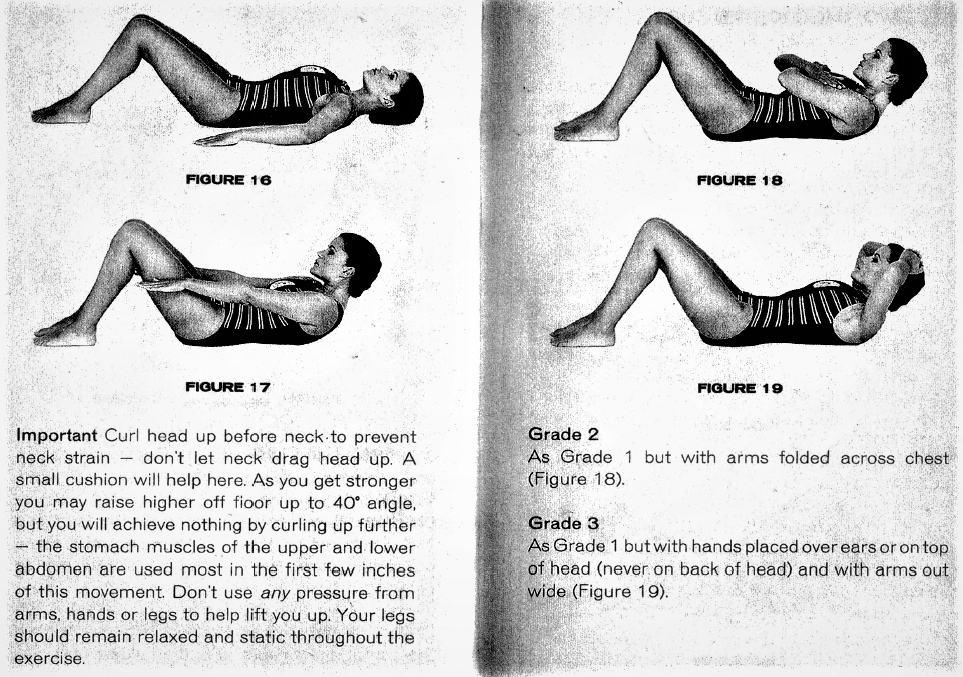
Wills, J. (1990). A flat stomach in 15 days, pp. 83–125. Sphere Books Ltd: London.
I did Judith’s stomach exercises for 30 years an hour a week before I joined a gym at age 67. For a book which cost $2, it was an absolute treasure!
Also remember: breakfast is important! Prof Christopher Gardner, a nutrition scientist at Stanford Medicine, California, says: “ … skipping breakfast would cause people to be hungrier, eat more and make poorer food choices later in the day” (Petersen, Andrea; 2025, May 1, The Australian).
David Raubenheimer and Stephen Simpson’s book ‘Eat Like the Animals‘ evidences 30 years’ research, concluding that it’s our protein appetite that must be filled: not too much or too little. Combined with a good balance of carbs, fats, sodium and calcium, your cravings for fibre-poor ultra-processed foods will slowly fade. Your reward? Trying on jeans one size smaller!
(Raubenheimer, D. & Simpson, S. (2020). Eat like the animals, pp.180–81. HarperCollins Publishers: Sydney.)
 Welcome to Shirl's Pearls: My Guide to a Good Life!