MOVE! 2.0

It’s true. I had a very early menopause at 36.  

Undiagnosed for nearly 2 years after my son’s birth, I was robbed of estrogen – that reliable hormonal ‘bone bank’ for women. So I wasn’t in good shape. But my bones would have degenerated much faster if not for my steep-hill walking routine. 

I was prescribed hormone replacement therapy (HRT); the tablets contained both estrogen and progesterone. A bone mineral density (BMD) test confirmed I was at medium-to-high risk of developing osteoporosis. 

As my wise friend and physiotherapist, Kate, wrote to explain it:

‘Bone mass produced from childhood, peaks at 25–30 years in both sexes. After this point, and from 30 on, the amount of bone in the skeleton begins to decline slowly.’

My calcium intake was low even up to the age of 30. Growing up in Singapore, the ‘milk’ we drank was either reconstituted or powdered; we drank very little anyway. Cheese was highly processed, boxed or canned, very salty, and imported mainly from Australia and the UK. Not like the lovely Australian natural cheeses I have now. Yoghurt? Didn’t hear of it. 

Even with Mum’s calcium tablets, my bone mass couldn’t reach acceptable levels. Lack of exercise and dairy foods, a low body weight and now worst of all early menopause, gradually contributed to my ‘porous bones’. I had little left in my bank to help stabilise this bone loss. (I will expand on menopause and osteoporosis (the latter also common in men), in MOVE! 3.0.)

So does EXERCISE hold the key to bone health and LONGEVITY in general?

Nick, who appears with trainer Dirk Hansen in one of our videos, has been a regular at the gym 5 days a week for the last 20 years without missing a day. I’ve met Nick: he’s 80, active, energetic and always has a smile!

So my advice to you is this:

You cannot avoid getting old, but INACTIVITY as you age is what you must avoid at all costs.

In her 2013 piece with The Sydney Morning Herald, Paula Goodyer quoted neuropsychologist Nicola Gates:

‘People who exercise have better cognitive function, especially memory and executive function (brain skills involved in organisation, planning and judgments) and lower dementia risk.

‘While our brains shrink with age there’s evidence regular exercise can help counteract this by increasing the numbers of brain cells and the connections between them, along with the extra blood flow needed to sustain this new growth.’

Once my hormones kicked in (it took a month to really feel better), I could take my morning walks to a new level. I knew it was either that or brittle, weakening bones. I maintained a rhythm of running 30 seconds, walking to recover and running again for almost an hour 4 to 5 days a week. I was actually practising High Intensity Interval Training (HIT) well before it was in!

I chose to start work at 9am instead of 8.30. I gave HR a medical certificate, and said it was either that or more sick days. I now needed to get my bone density close to normal or average. Thankfully, the BMD test 6 months later showed marked improvement.

But a year later, I found I was trying on size 10 pants, up from a size 8. Oh well, I shrugged. It wouldn’t do any harm if I went a little over 45kg.

However, it took only a few months before size 12 felt more comfortable. This time, I left the pair I was trying on in the changeroom. NO … I was definitely not buying a 12! I was now hitting 48kg, and for one 1.52m tall, it wasn’t good news. Fifty kilos and 14 loomed large if I didn’t act quickly. 

I realised HRT was contributing to my weight gain – most evident around my waist and tummy. I needed to exercise more, but which to choose?   

I discovered Judith Wills’ book A flat stomach in 15 days at a garage sale. How amazing that when you have a goal, a path lights up to show you the way! I so loved the book, and referred to it in my ‘Diet and Your Colon’ section. One sentence struck me especially: 

‘Without strong “abdominals” your stomach will never be really flat.’ 2

Wow. At the time, I believed the hospital exercises I was given were only for the first few weeks after childbirth. So I actually needed to strengthen my ‘abs’?   

I read the chapter from Wills’ book again. She used a grading system: you do Grade 2 only when you’re comfortable with Grade 1. Judith explained why a particular exercise was good and how to do it properly. I followed her instructions, chose a smallish quiet room, bought an exercise mat and a small flat cushion to support my head. Have a look the exercises3

The flat-stomach promise was for 40 minutes every day for 3 weeks. I had to avoid ‘negative foods’ – i.e. refined starch foods. Completely in tune with all that Dr Walker talked about. I identified my daily devotion to rice; I had to reduce it for that flat stomach. 

TAKE COMFORT – it wasn’t easy for me. I could only manage 1 hour on the mat once a week: that’s why it took me 3 months instead of 15 days! But I got that flat stomach, and came down to a size 10. After another year of walking, the mat exercises and of course the right, consistent diet, I revisited my size 8 wardrobe. It was so glad to see me! 

I’ve stuck with this program for over 25 years now. It still worked – but being ‘Shirley’, I knew I had to do more. I wasn’t building any real muscular strength and my posture was still slouchy.  

We’re now muscling in to MOVE! 3.0. I’ll expand on HRT, give you men and women help with osteoporosis, and why I had to take my next big step later in life to join a gym.

 1 Goodyer, P. (2013, August 3). ‘Let The Mind Games Begin’. The Sydney Morning Herald.

 2 Wills, J. (1990). A flat stomach in 15 days, p.83. Sphere Books Ltd: London.

 3 Wills, pp. 102–103.

Regular as clockwork or LATE?

Weren’t most of us given laxatives as kids if we didn’t ‘go’ for more than a day? Believing we needed a good clean, we bravely bore those awful cramps and diarrhoea … 

But sadly, CONSTIPATION is still in top spot as our most mistreated chronic disorder. 

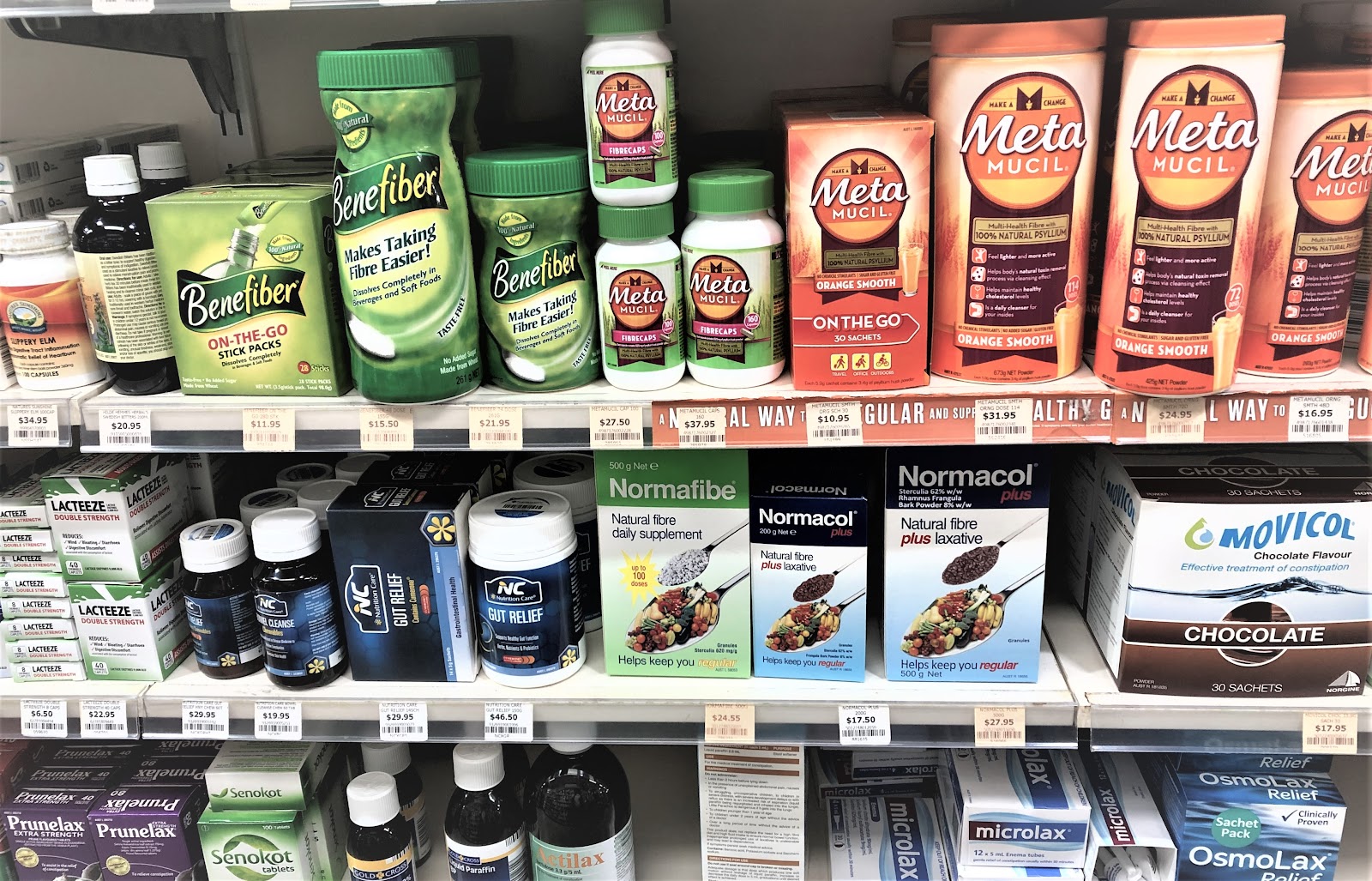
A large range that could make you go ‘lax’ 

While today’s ‘added fibre’ and probiotics are less harmful than laxatives, they are still cop-outs to prevent us from EATING WELL. Probiotics are good during and after a course of antibiotics – but they are not an alternative to a decent serve of citrus with the pith in the morning, which will ensure your colon produces its own wonderful microbiomes. You’ll certainly recover faster. 

Raw vegetable juices, e.g. beetroot and carrot in particular, are best for constipation. If you don’t have a juicer, finely grate a dessert spoon of raw beetroot in your lunch and dinner salads. Warm water with lemon juice, or aloe vera juice and green apples also help you to stay regular. I guarantee you’ll be out of the bathroom smiling the next morning. 

But if you really like prunes and psyllium with your rolled oats, make sure you drink enough water. Some good advice from food and health journalist Judith Wills: 

‘Fibre in that form and the high-sugar content in dried fruit need much more water to be processed and I assure you, drinking a lot of water will NOT cause bloating or fluid retention. The surplus will be flushed immediately out of your system.’1

And: 

‘There is no point in preventing constipation with a high-cereal, pulse and dried fruit-fibre diet if all you do is blow your stomach up with uncomfortable wind instead … it is not just fibre that keeps you regular. I believe that more constipation is caused by not drinking enough water or eating enough citrus fruit … ’ 2

In short, ads promoting high-fibre foods and cereals simply deceive and mislead you. Don’t listen and mute the audio immediately!

After my 3 colonics (and no more for at least 6 months), I followed Anna Paredes’ advice: 

Drink 3L of water, slowly during the day
Add beetroot, grated carrots to salad (or juiced carrot & beetroot)
A green apple (less sugar than other varieties) which I now have 2 hours after breakfast 

Together with the powerful, rejuvenating effects of grapefruit (with pith) first thing in the morning, followed by either a kiwi fruit or red papaya, I am now regular without the slightest trace of constipation. Liberating!

The old breakfast cereal with milk is so quick and easy to slurp down with your tea or coffee. You’ve done it for years, your kids have it too, and there’s just no time in the morning …

Following my regime will take more time to prepare – but you and your family will spend less time at the doctor’s and less money at the pharmacy.  

If you’ve been taking laxatives – ‘natural’ or otherwise – for a long time, I recommend having  a few colonics to re-hydrate and revive your colon. Once done, your new laxative-free diet will work better. 

In No. 8 of Body Health, I introduced you to Anna Parides at Sydney’s Colon Care Centre. In her very own words, Anna says: 

Older people would benefit from having colonics. Overall, there would be a lifetime of inflammation (mucous) that has built up within the colon, inhibiting proper hydration. Lack of hydration reduces proper absorption of nutrients within the small intestine from the foods we eat. For example, refined starches soak up lots of water as they go through our digestive system in order to be metabolised. 

‘We don’t get to eliminate all the food that we consume on a daily basis, so old food and dense nutrient food tend to build up depending on how dehydrated the colon is, making the entire body sluggish and you feeling constantly tired. Eventually this will have a detrimental effect on the immune system and in time cause dementia, arthritis, diabetes and other autoimmune diseases.

‘Exercise will also stimulate the lymphatic system – one of our elimination organ systems. Lymphs that have been stimulated can aid bowel motions. As a supplement you can take magnesium before bed and don’t forget to drink your 3 litres of water during the day.’

Okay, folks – I think you’ve enough from my posts on Diet and Your Colon to get you started. Whatever your reasons – healthier eating, losing or maintaining weight, please keep my words in mind.

Please watch ‘Everything comes down to poo’ again from the old TV series Scrubs

Wills, J. (1990). A Flat Stomach in 15 Days, p. 29. Sphere Books: London.

 2 Wills, p.28.


Sugar addiction, kids’ health & weight loss recaps

Our 2 LOVES

Sugar is the first. Yes, it’s highly addictive and one of the most difficult cravings to control. We simply blame the ‘sweet tooth’! 

BUT … my theory is that we can still enjoy our cakes, choccies and ice-cream – as long as we avoid them after a main meal, and keep portions moderate. Having a few nuts (walnuts or almonds are best, which I always carry with me) with your desserts will release blood sugar more steadily and slowly, and help the pancreas maintain its blood-sugar balance.

I realise that for some of you, just one mouthful of anything sweet will trigger a feeding frenzy. So in this case, avoid it altogether! Having more protein and less carbs with your meals will reduce sugar-cravings. 

Alcohol is the other. We ‘need’ wine, beer and spirits to unwind, relax, enjoy, forget. It fills our glasses and looks good in our hands. But please read this link from the Mayo Clinic on how more than 2 glasses of alcohol a day can damage the body. I’m afraid the ‘red wine is good for you’ theory is all but debunked! (And by the way, it sets the wrong example for your children to follow. Even giving them a little taste can set an addictive pattern.) 

But you know what? I LOVE parties, conversations and having a good time! I’ll have wine, a cocktail or beer if I feel like it but not with my meals. My wine glass is quarter-full, and spirits to less than 200mls. That’s all for the whole evening. And I’m up the next morning feeling pretty good!    

Now, let’s help our kids!

West Aussie bro & sis (rarely so pally)
Wollongong baby Elsie at 10 months  

Did you know social media, particularly YouTube, abounds with young ‘kidfluencers’ targeting other kids? As much as 90 per cent of YouTube videos directed at kids promote junk foods like ‘milkshakes, French fries, soft drinks and cheeseburgers’. Such blatant marketing is also strongly linked to the growing scourge of obesity in children.1

A ‘wellness expert’ on radio has said that giving children a ‘broad spectrum probiotic’ was good because ‘there is nothing worse than a constipated child’.

But what of the DIET of the constipated child? Are kids not gobbling up biscuits, nuggets, chips, and demanding everything ‘yummy’ seen on ads everywhere? So will you now simply give them probiotics to undo the harmful effects of junk food? Or will you encourage them to chew on an apple, a carrot or something that hasn’t been cooked or sweetened? This is essential fibre that they need.  

You can read all you need to know for healthy growing children in Chapter 12 of Eat Like The Animals ‘A Unique Appetite’.2

So what should we do?

  • For school-age kids, the first step is to wean them off sugary fruit drinks. Put fresh fruit in their lunchboxes and a bottle of water instead. While we cannot control what they eat outside, you can at least ensure their lunches are healthy! 
  • Make them choose at least one salad vegetable (possibly cucumber or tomato) for their sandwich (provided it’s not with peanut butter). You might consider a small reward.  
  • Teach them the value of healthy eating, and that processed sugary foods are HARMFUL. Tell them a banana, dates instead of fries will give them ENERGY to play their favourite sports, and that sugary drinks cause bad teeth and more time at the tooth doctor with the drill!
  • Make their diet 70% fresh foods, and get them to drink more water. Provide some entertaining kids’ health books to read. Children love stories and have an enquiring mind. As long as they know why, they will react positively.

    I recommend Andrew Solway’s Your Body Inside and Out for 6-year-olds and above. It has kid-friendly diagrams of the human body, including the digestive system. He stresses the particular link between ‘sugary foods’ and tooth rot, where acidic bacteria produced from such foods erode teeth, and the importance of having 5 fruit and veg portions daily. He echoes my words: 

    ‘We should only have small amounts of sweet or fatty foods … Foods such as crisps and takeaway foods are fatty and have lots of salt. If you eat a healthy diet when you are young, it will keep you healthy and strong into old age.’3
  • Better still, introduce toddlers to healthy food early, and get them used to chewing.  Introduce rolled oats instead of processed cereals for breakfast – honey and sultanas on top will be yummy for them! Avoid white bread if possible, and introduce apples and raw carrots as finger foods

Weight loss recap

  • Don’t diet to extremes – you’ll only revert to your original eating habits. Instead, eat less. Your stomach will contract and you’ll eventually feel uncomfortable when you overeat.
  • Keep to my method of reducing carb portions slowly. Choose unrefined starches over refined.
  • Switch your low-fat milk, cream and yoghurt to full-fat. Low-fat anything has extra sugar and additives you don’t need. 
  • Remove all sugary drinks (‘Zero Sugar’ in soft drinks will not tame your sweet tooth or reduce your cravings, but only bloat your stomach). Drink less alcohol, eliminate dessert and fruit after main meals. This will give amazing results (no bloated stomach or flabby waist for one.) The reward? Cravings for junk food and sugar will slowly but surely disappear. 
  • When you know you’ll be out for a while, always take water, an apple or even a healthy sandwich with you – hunger will only lead you to a fast food counter. 
  • When your brain says ‘have more’, don’t listen. STOP after you know you’re past your usual amount. In less than 2 hours, you’ll be glad you resisted – you’ll feel full, and not be tormented with that ‘wish I hadn’t eaten so much’ feeling.

Professors David Raubenheimer and Stephen Simpson in How to Eat like the Animals perfectly summarise practising good eating habits and not dieting to extremes:

‘It’s like learning a sport, to play a musical instrument, or to drive an automobile: at first it takes concentration, consciously applying the rules, rehearsing them and unlearning bad habits. And then it becomes second nature. Unless there are specific medical reasons, you don’t need to cut out on any food group or eat things that you don’t like, or that are not appropriate to your food culture. It’s just an issue of proportions.’4

Lastly, a quote from geneticist Dr Giles Yeo, author of Gene Eating:

‘The most important truth is that food should be understood, not feared’.

1 O’Connor, A. (2020, November 6). Are ‘kidfluencers’ making our kids fat? Sydney Morning Herald [from The New York Times]. Retrieved from https://www.smh.com.au/lifestyle/health-and-wellness/ are-kidfluencers-making-our-kids-fat- 20201106-p56c1v.html

 2 Raubenheimer, D. & Simpson, S. (2020). Eat like the Animals, p.151. HarperCollins Publishers: Sydney.

 3 Solway, A. (2007). Your body inside and out: Food and digestion, pp. 9, 28, 29. Franklin Watts Australia: Sydney.

  4 Raubenheimer & Simpson, p.202.

11. Regular as clockwork or LATE?


Your NATURAL detox

Most lifestyle changes start with DESIRE. Nothing will force or encourage you to change if you don’t want to! 

So if you’re healthy, energetic and motivated … well done!  Read this to be simply entertained. But if you say, ‘Yes, I need to wake up to myself!’, I will give you simple steps to take you where you want to be.

The way we feel is the result of what we eat, what we do and how we think.

What should we eat or drink? 

  • Remove or slowly reduce sugary soft drinks. If you’re addicted to the 3pm-Cola-fix, try diluting it (like I did). You’ll make a bad face, but you will wean off it. Maybe replace it with tea and milk, or black tea with honey and lemon. By eating less sugar and more ‘real’ foods, you help your cells to burn glucose and fat. 
  • Your default go-to drink should be water, preferably filtered. You should restrict your regular coffee or tea fixes to no more than 2 to 3 cups a day.
  • Drink water before you feel thirsty. Thirst is your warning signal – don’t wait for it. Drinking enough water is important, especially in dried-out air-conditioned rooms. Headaches are mostly caused by dehydration. Have that glass of water before reaching for paracetamol or aspirin. Your kidneys will have a few extra years of life! 
  • Remove or reduce ‘empty’ carbs falsely glorified as ‘comfort foods’ – e.g. muffins, scones, croissants and ice cream. Instead, keep a variety of good quality, crafted bread – e.g. seeded, sourdough, rye, turkish or pita. Denser, grainier breads are more satisfying, so you eat less. Their low GI means they are digested slowly and will keep your blood sugar levels stable. Have a look at a range of low GI foods
  • Reduce consumption of red meat, chicken and high-cholesterol seafood. Low-fat turkey breast is better. Also have quality fish such as sardines, salmon or flathead more often. Watch me cook succulent chicken breast. I marinate it with a little soya milk, Moroccan seasoning and Keens Curry Powder for 1 to 2 hours, then pan-fry with olive oil. Enjoy!
  • Stock your pantry and fridge with fresh veggies and wholesome foods. With healthier eating, your cravings for super-refined and colon-harming foods will slowly disappear.

Morning

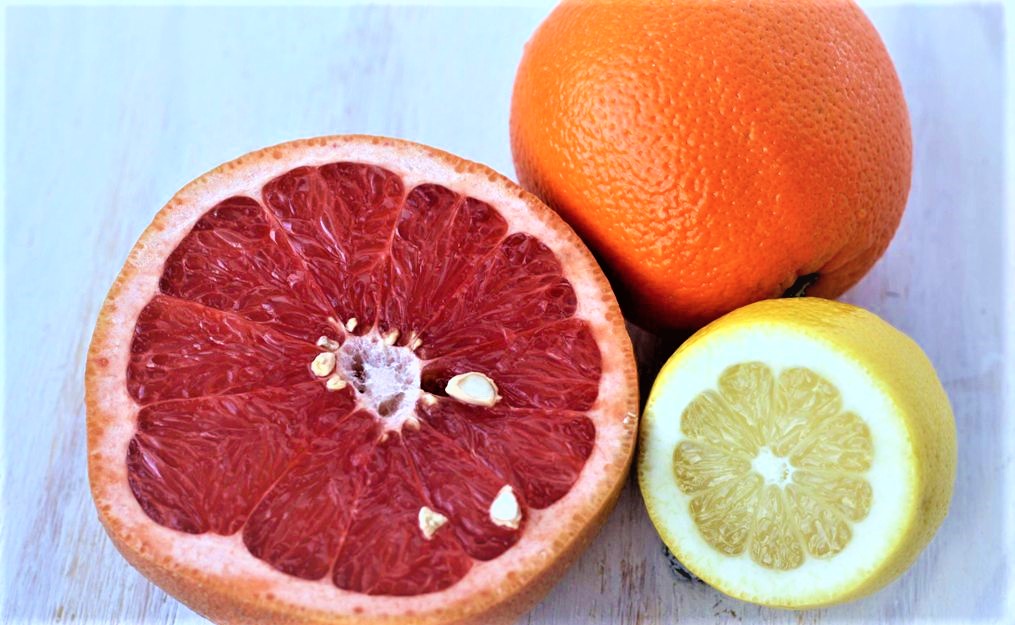
  • A quarter or half a grapefruit or orange with pith, and 500mls to 1L of warm water. The abundance of antioxidants in citrus piths cannot be overstated! (If pressed for time in the mornings, cut up the fruit the night before, cover with cling-wrap and refrigerate.) Here’s my fruit prep video again. 
  • Follow with enzyme-rich fruits like red papaya (with a squeeze of fresh lime), kiwifruit, an apple or a mandarin – but not bananas. Eat bananas alone or with nuts. They are richer in carbohydrates and take a longer time to digest than other fruits.
  • Have nothing else for at least 30 minutes. You won’t feel hungry because the sugar in the fruit will sustain you and will be nicely metabolised when you have your ‘real’ breakfast. Contrary to what you’ve been told, fruit eaten this way will not make you fat: it will help detoxify your liver and cleanse your system!
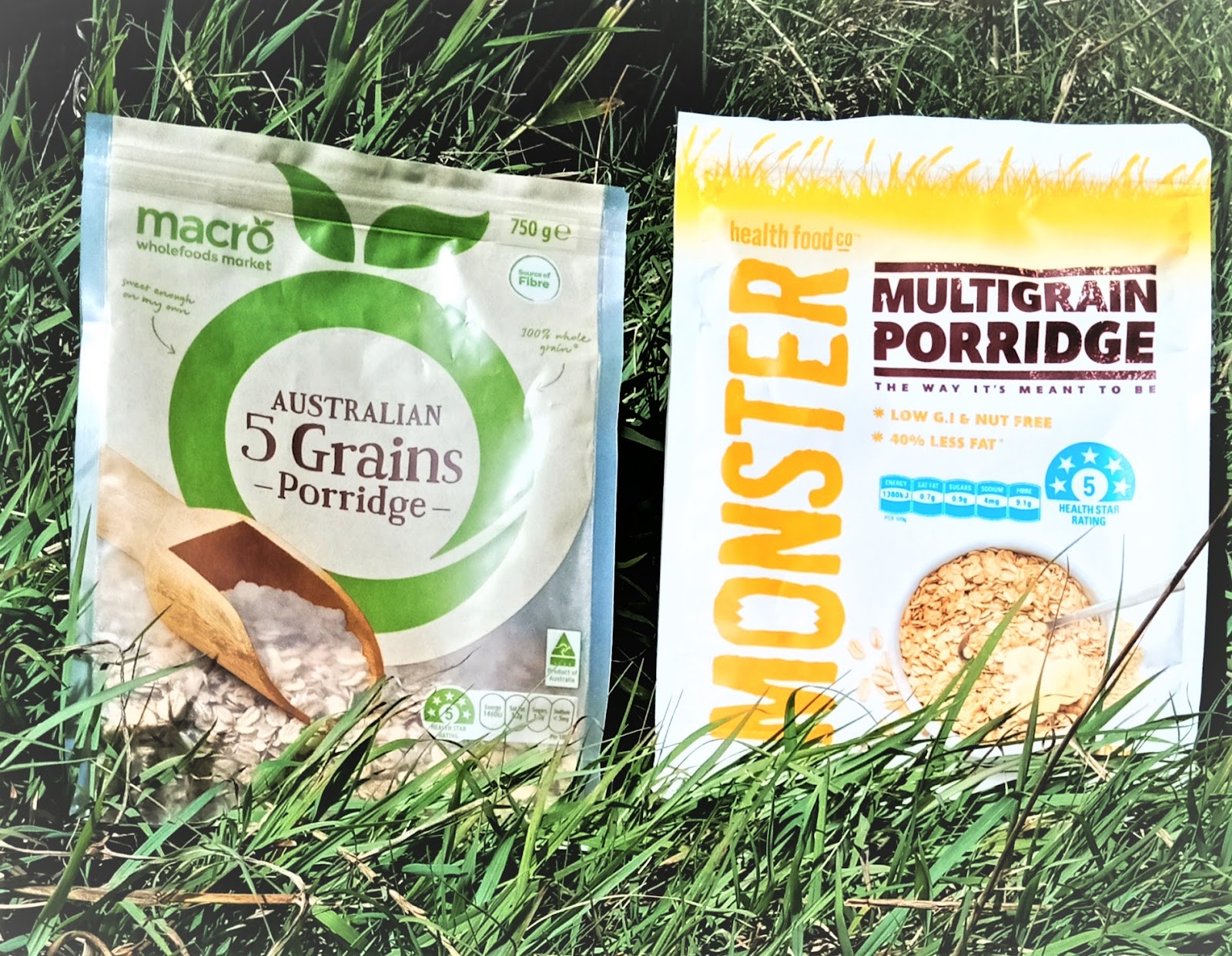
  • Breakfast suggestions:  Rolled, spelt or multigrain oats with honey/bananas/raisins/dates OR whole-grain/sourdough toast with ricotta/cottage cheese (or whatever you prefer) AND/OR an egg cooked any way you like. (I’m not following Dr Walker’s suggested combinations here, as I found my breakfast choices didn’t cause discomfort. Fruit first thing in the morning, and avoiding carbs rich in sugar and additives are more important.) 

Mid-morning

Skip processed, sugary cereals for this
  • Full-fat yoghurt (not low-fat, it has too much sugar). ‘Natural’ Greek yoghurt is good, but always check the sugar content (avoid anything over 8g). A small tub is fine. Sweeten your yoghurt with a little honey if needed. 
  • A large green apple with the skin – perfect if you’re constipated.
  • You can now have your banana and 2 to 3 dates, with a handful of walnuts or almonds. Or try Ryvitas (1–2 slices) or Vita-Wheat with Vegemite, banana or honey. Ditch the bickies – this has more fibre, little salt and almost no sugar. 

Lunch

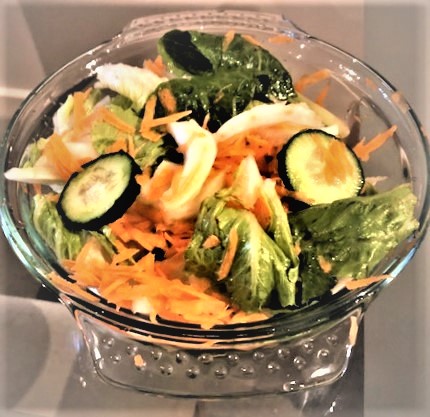
My lunch/dinner raw salad – cos lettuce, cucumber, fennel, grated carrot & apple 
  • Resist buying your lunch, except on special occasions. Save your money, and lose the weight (and the wait).
  • Prepare a large bowl of salad a day before to have for lunch and dinner. It takes 30 minutes tops, and keeps for 2 days in the fridge. Grate the apple only when the salad’s ready. Varieties of pre-washed packaged salads are available in supermarkets (but watch those use-by dates!).
  • If you really want a sandwich but want to lose weight, slowly limit sliced bread. You could leave out carbs entirely, but you’d probably be ravenous in an hour and become twitchy. I’ve stuck to 2 thin slices of any one of the breads I mentioned before with plain butter or Proactiv. Add the salad after toasting your sandwich; using a sandwich press makes it that more crisp and delicious!
  • Make your sandwich fillings one of these: avocado, cheese, chicken, tuna or ham. An avocado and salad alone will keep you full if you don’t want bread. 
  • In my experience, I believe food metabolises faster if you stick to a single protein with your salad; Dr Walker wouldn’t agree with adding bread, but I found it didn’t affect my weight or digestion as long as I kept to this combination. Adding protein in your sandwich will also keep you full for longer.

Right food combinations = faster metabolism = weight loss!

Mid-afternoon

  • THAT’S the time we crave sugar, caffeine, or worse – nicotine. (Wouldn’t it be nice if we could have half-hour siestas at work?)
  • Again, avoid those empty carbs I listed earlier. Replace with quality breads (seeded, sourdough, rye, turkish or pita). Toast a slice, and add cheese or peanut butter. It’s much better to snack on this between your main meals. (If you must have your slice of cake, this is the best time to have it.) Adding a few almonds or walnuts will slow down sugar absorption.
  • 3 to 4 tablespoons of full fat yoghurt OR an apple, pear or kiwifruit. Remember: always eat fruit alone.
  • Also a good time to have complex carbs like dried figs, apricots and pears – high in fibre, calcium and abundant minerals, great for weight loss. Have 2 to 3 a day with a handful of almonds or walnuts. (Soak dried fruit overnight to remove its high sugar content.) Include dates – one of the richest forms of natural carbohydrates. They are highly alkaline (i.e. non-acid forming), and a great gluten-free snack. Watch my dry fruit prep video.

Dinner 

  • Firstly, do have a large salad, even in winter!! I’ve ditched the soups and now have salads instead. 
  • Follow with semi-cooked or steamed vegetables, adding garlic and/or ginger but no salt. A little oyster, teriyaki or soy sauce will do instead – you’ll actually taste the richness of the vegetables!  
  • Add lean, simply-cooked proteins. I prefer less fatty chicken or turkey breast, but Scotch Fillet or Porterhouse beef are OK (cheaper blade cuts are fine too). Good oily fish like salmon or sardines top the list – which you can either stir-fry, broil or grill.  
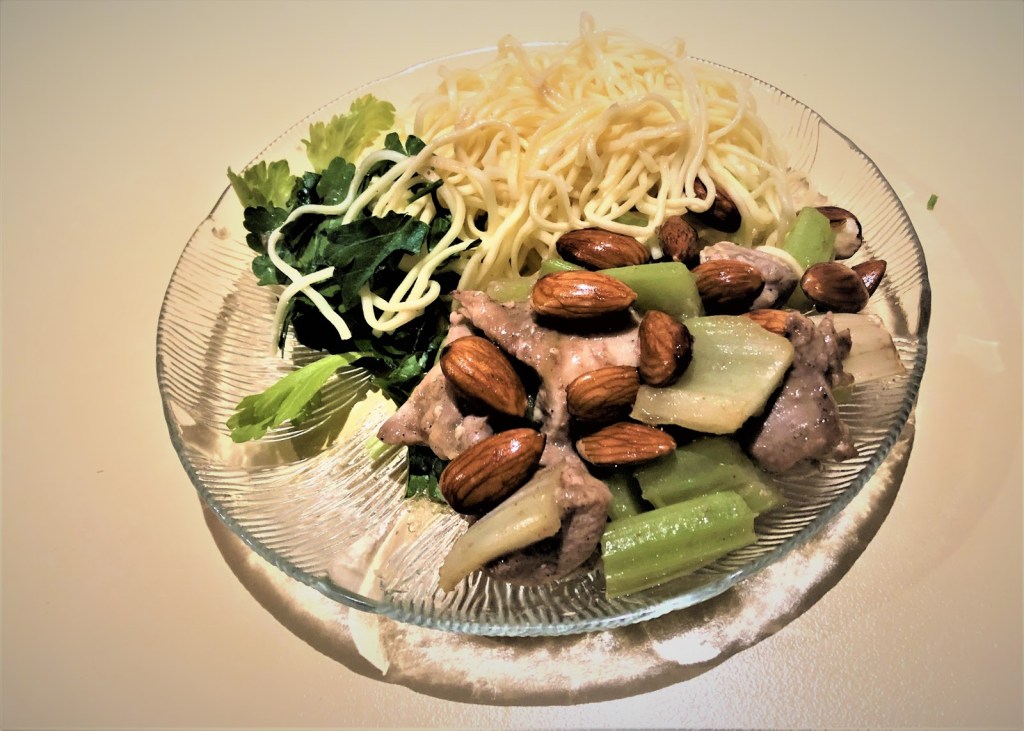
My stir-fry chicken, almonds, celery & noodles

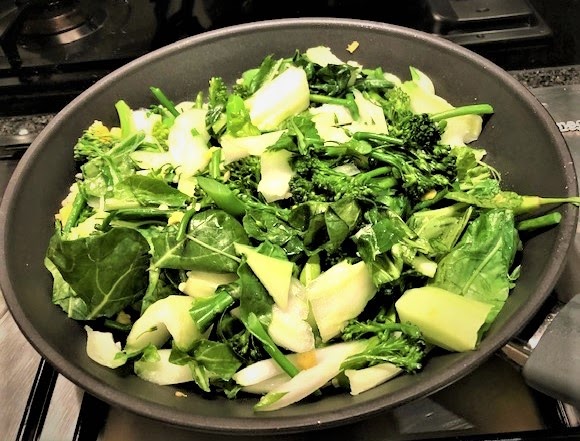
My stir-fry broccolini & ‘moon bok’ with garlic & ginger

Your (easy) prep

  • This is the key. Most importantly, always have salad vegetables in the fridge. Celery, fennel, cos lettuce, carrots are perfect – if you’ve no time to be creative, just wash and chomp while cooking the rest of your meal. Watch my earlier video here.
  • When I was working, I’d set aside 30 to 45 minutes to prepare my meals the night before, i.e. my morning citrus, a salad (with enough for dinner), and sandwich for lunch, and midday snacks.
  • Marinate meat, chicken or fish ahead of the evening dinner. Know your side dishes. The worst thing you can do is to come home hungry, wondering what to eat! 

You will adapt to this new routine and find your rhythm. 

Supper

You’ll get a bit peckish around 9 or 10pm, especially if you’ve had an early dinner. Most diets forbid eating after 9, but I don’t think it matters as long as you are smart with your food choices.

Here are 3 suggestions:

  • Dried pear, apricot or figs (always pre-soaked to leach out the sugar) with a small dollop of fresh cream … so delicious. 
  • A tablespoon of plain yoghurt with half teaspoon of raw honey … very soothing, especially before bed. (Dairy products contain the amino acid tryptophan, which promotes good sleep.)
  • A slice of Ryvita with cream cheese, vegemite or peanut butter.

Give it a few weeks, and you’ll see a new you – simply by eating affordable and available food. You’ll have more energy and sleep better.  

And need I mention better-looking poo? Your reward for giving up some of your ‘slouch on the couch’ and screen time.

IT WILL BE WORTH IT.

10. Sugar addition, kids’ health & weight loss recaps


Colonic hydration

Sadly in the old days growing up, we had enemas to ‘clean out’ our stomachs. Mum would take us, screaming all the way, to Gran’s for the monthly enema – a pink, fearsome-looking pump to us kids. Milk of Magnesia was the other ‘opening dose’ given (even if we didn’t need it 😩 ).  But I have news for you: laxatives and enemas won’t remove all waste that’s stuck in your colon. I remembered Dr Walker: 

‘ … use of laxatives are not only habit forming but decidedly disruptive to the membrane of the intestines. … they disturb the normal rhythm of the excretory organs, which sooner or later rebel.’1

This image has an empty alt attribute; its file name is nfWPsjjJ08l84EwUxrZI5xRpGgSUFSfBEuuBNJtzrD_lp3eznW70YRYDA0WDwM44UFE5WGnWJyVQEH7-SMWoOBfCaTOlldtbgoSzNKmkYXtcZKUJeN3IrV1SasclXcwIHWCtNL03
Deeply unsettling … the old rubber enema

So no more laxatives, please. You won’t need any with your servings of fibre-rich raw salads

I finally jumped in and made an appointment with a trusted colonic hydration clinic in Sydney. Do your research. The expert clinician I found, Anna Paredes, has had over 35 years’ experience in her well-established practice. But did I really need to have this? YES – apparently, we don’t fully eliminate our daily food, leading to accumulated OLD FOOD, including nutrient-dense food. 

Anna also advised against taking any laxatives before my appointment – and in fact never to take them at all (as Dr Walker said). What a throwback from my childhood days! The colon apparently needs proper hydration to contract and release waste matter. Laxatives only dehydrate and inflame.

The day arrived. I walked in, nervous and apprehensive, looking around the waiting room. Warm, calming colours greeted me; what’s more, there was nobody over 40 there. I had the audacity to think only flatulent fuddy-duddys with erratic bowel habits had colonics!

But according to Anna, older people would in fact greatly benefit from this treatment because it would hydrate their colons. With a lifetime of intestinal inflammation and mucous build-up, simply drinking water to hydrate the colon would have limited effect. 

Mucous in the small intestine would also prevent proper absorption of food nutrients. And depending on how dehydrated the colon is, the entire body and mind will be SLUGGISH – harming the immune system, increasing stomach acids and making us tired. The end result? Dementia, arthritis, diabetes and other autoimmune diseases. Oh no. 

Now back to the clinic. 

I saw two young men in the room, very relaxed and looking at their smartphones; they couldn’t have been over 30. Another client was a 25-ish well-dressed girl, smiling broadly while I socially distanced in one of the chairs.2

Did I miss something, waiting this long? 

I was ushered by Anna to the treatment room. She knew I was nervous (my heart-rate matched watching up-close live footie!).

I lay on the bed, covered below the waist with a towel, and was told to take deep breaths through the mouth. Anna placed her hand on my tummy, feeling my diaphragm lift up and down; my heart rate slowly returned to normal. 

I guess it was the moment before the speculum was inserted that worried me most. Would it hurt and be uncomfortable? I turned to my left – with the gel, it went in smoothly and was painless. I could now lie on my back.  

Anna sat next to me while operating the equipment in front of her. Warm filtered water slowly trickled into my large intestine. She monitored the flow, massaging my tummy. I could feel gas pockets disperse and break up while the colon was being hydrated.  

The water was turned off at the right level, and I could see the impacted faecal matter (IFM) coming through the tube, finding their way to the adjoining toilet’s waste pipes. 

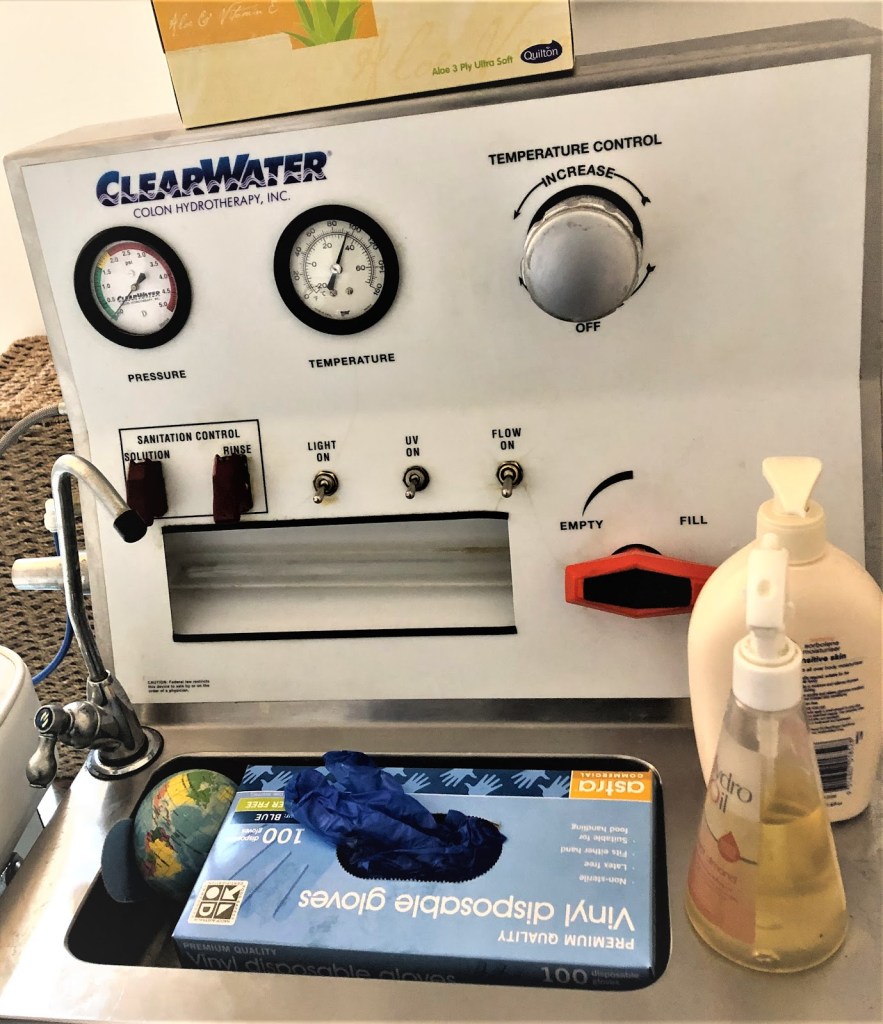
Colonic hydration panel with pressure & temperature meters & temp. control; long window shows tube for faecal matter (its shape & colour can reveal colon health)
Colonic hydration disposable catheter tubing
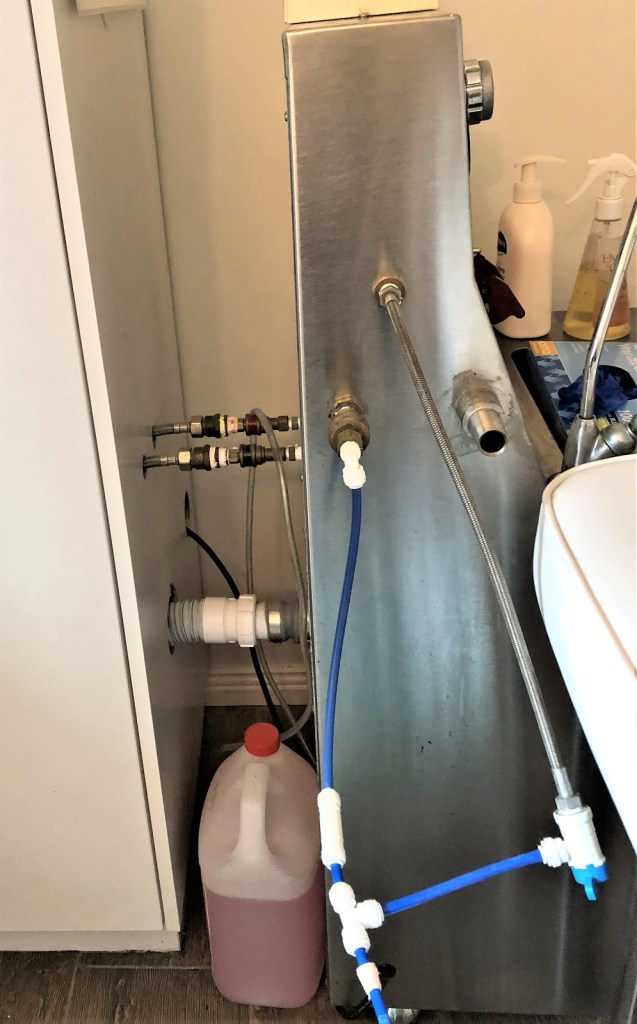
Panel side view showing pipe connections

Just as you’d want your dentist to display your extracted abscessed tooth, you’d certainly want to see what’s come out of your colon. The BIG REVEAL? In my case, it was quite a lot! 

This routine was done about 4 times; each time I felt the gas pocket (detected in my last colonoscopy) slowly dissipate. It caused some discomfort, which eased after the third and fourth hydration.

Anna left the room and gave me time to get dressed and use the bathroom. She suggested I have the second and third colonics a week and 10 days apart, and the fourth 3 months after.  This would complete the initial process of removing most of the impacted poo. She then recommended a colonic every 6 months to a year. 

I felt ‘light’, clean and vitalised as I left, and made sure I booked my second colonic. It was certainly not the same as having a good laxative ‘run’ (if you know what I mean). I had an overwhelming calm which lasted the rest of the day, with an unbroken 7 hours of sleep that night (I typically get 6, often even less).

My second colonic gave even better results, with much less IFM. My gas pocket had almost gone. And I scheduled a third colonic. I was advised what foods to avoid, and foods to keep my colon healthy and hydrated. I also had to drink at least 3L of water daily.

Friends, colonics are not a cure-all for your ills. You don’t have them to flatten your belly or lose weight. But they provide thumbnails of the health-screen I want you to see.  

Your health shouldn’t deteriorate as you age. High-blood pressure, diabetes or arthritis are not the result of age. They are the result of our being ignorant as to how our lifestyle is damaging our health.

So folks – you’re now armed with enough information to improve your eating habits. But how do you do this if you’re already finding it hard to ‘keep up’, you’re always ‘tired’ and ‘have too much to do’? The answers are in my next blog. 

And by the way, if you’re living in Sydney and decide to have a colonic, I highly recommend the Colon Care Centre – a thoroughly professional, reputable and trusted company in the industry for over 3 decades. 

And if you really want to see how colonics are done, please watch the video of my colonic done at the Colon Care Centre. 

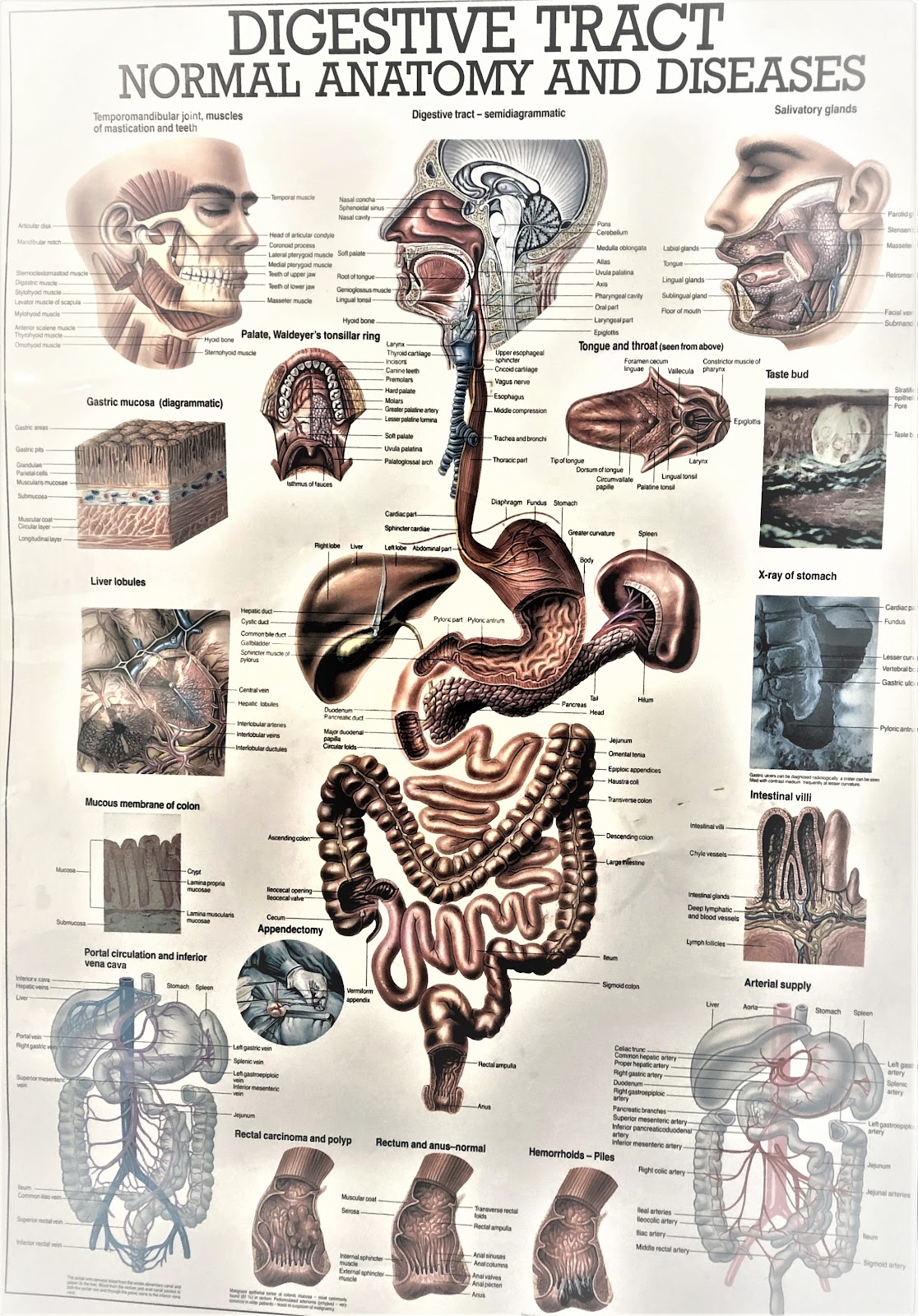
Digestive Tract Chart (courtesy of the Colon Care Centre, Sydney)

 1 Walker, N.W. (1979). Colon Health: The key to a vibrant life, p.23. O’Sullivan Woodside & Co: Phoenix, Arizona.

 2 This was in 2020, during Covid19’s social distancing protocols.

9. Your Natural Detox


Steps to a clean colon

In his book Diet & Salad, Dr Norman Walker stressed the importance of eating raw foods and those that were actually compatible with each other – plus 2 more essentials:

  1. Having raw, fresh vegetable juices (mixed in a proper juicer, not one that pulverises and liquifies):

‘ … this is the most satisfactory way to extract all of the vitamins, enzymes, amino acids and minerals from the vegetables … the rebuilding and regenerating properties in the juices are the quickest means by which the body can be brought back to a normal condition.’1

Walker recommends approx. 500mls per serving, diluted if you prefer, at least 30 minutes before meals. But his favourite is carrot juice:

‘ … raw carrot juice stands supreme. It is a particularly wonderful cleanser of bile and waste matter accumulated in the liver as a result of years of wrong eating.2

2. Having colonic irrigations

Simply put, a proper colonic irrigation (or ‘hydration’ as it’s now known) flushes low-pressured filtered water into the colon through a sterilised tube attached to a speculum. Faecal matter and gas blockages are removed from the colon through a second tube. The process takes about 30 minutes to an hour. 

‘ … Like the removal of plaster, the faecal coating of the colon must be thoroughly soaked and saturated in order that its removal may take place gradually, comfortably and effectively.

‘ … every man and woman, if they have any desire to live a long and healthy life should seriously consider taking a series of colonic irrigations and get started on this cleansing program … thereafter, about twice a year, throughout life, colonic irrigations should help keep the body healthy.’3

To have my ‘impacted faecal matter’ removed appealed to me. Now, what about you?

I did want to live a long life without the chronic conditions of old age. Reading this in 1981, I was reluctant if not somewhat prudish to have my colon irrigated.  

Lying on a bed, no underwear, with a tube up my backside? No way. 

But as I write this in late 2020, I’m 71, and … THE GUT IS IN!!

We now see bowel screening kits promoted on TV; poo transplants effectively treating bacterial gut infections and metabolic syndrome, with recipients improving insulin sensitivity to better control blood sugar; cafes and juice bars promoting ‘gut cleanser’ drinks; and pills, fibre supplements and cereals claiming to produce a ‘healthy gut’ …

I pulled out my folder of Paula Goodyer’s articles. Paula had weekly Saturday columns on nutrition in the Sydney Morning Herald; everything she wrote was worth keeping. I recall reading her article ‘More than a Gut Feeling’ in 2012. She said: 

‘ … microbes in our gut may contribute to hard-to-treat problems such as allergies, autoimmune disease, irritable bowel syndrome and even obesity and diabetes.’

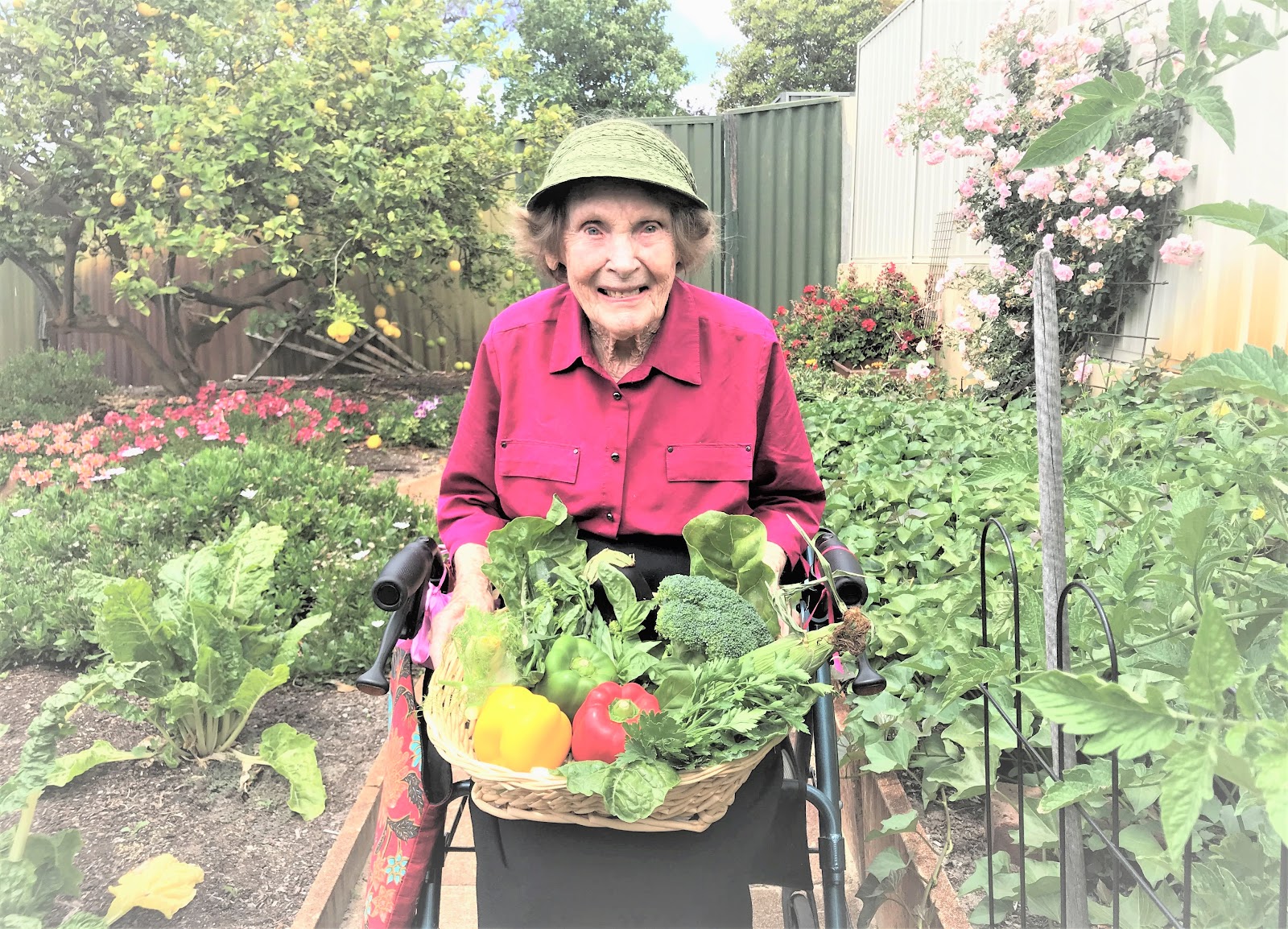
Healthy living at 98 West Aussie great-grandma Elsie in 2020 

Paula quoted Prof. Tom Brody, a Sydney gastroenterologist, who said dietary fibre provides food to help good microbes flourish.

Has my ‘regime’ blessed me with good microbes? 

I believe it has. Thirty-five years of diligent timing and selection of food plus regular exercise have kept my weight stable. I have normal blood pressure, low cholesterol, and excellent urine and blood tests.   

But would I feel this good in 10, or even 20 years? 

Dr Walker died in his sleep at 99. In the Foreword to Colon Health, he wrote: 

‘ … I am never conscious of my age. … I have never been aware of being any older, and I can say, … that I feel more alive, alert, and full of enthusiasm today than … when I was 30 years old. … my best years are ahead … I never think of birthdays, nor … celebrate them. … I am enjoying vibrant health, I don’t mind telling people how old I am: I AM AGELESS!’4

Folks, I’m now heading to my third colonic.

 1Walker, N.W. (1940/1970). Diet & Salad, pp.40–41. Norwalk Press: Summertown, Tennessee.

2Walker, Diet & Salad, p.118.

3Walker, N.W. (1979). Colon Health: The key to a vibrant life, p.21. O’Sullivan Woodside & Co: Phoenix, Arizona.

4Walker, Colon Health, iii.

8. Colonic Hydration


Lose weight, feel fit: NO drugs or fad diets

You know what? I suspect you won’t take my food advice well. And you’ll most likely be offended. But please think of it as something to consider if you’ve been battling any of the symptoms I’ve described.  

People I’ve not seen for years ask what my ‘secret’ is. If they were truly keen, I’d refer them to Dr Walker’s books.

But to you, it’s this:

Select, separate and time your food. 

My old eating habits took months to break, but I was determined. Being disciplined was the most difficult, but it was key to achieving my goal.

I totally cut out cola drinks, biscuits and lollies. You will not find them anywhere in my home. 

It suited my lifestyle to mix carbs with meat, but my portions of rice, noodles and pasta are now smaller.

I also have a weakness for crafted bread like sourdough, but by cutting out the ‘bad’ carbs and sugary drinks, I can enjoy 3 to 4 slices a day without putting on a gram!  

I have fish, especially sardines and salmon, choose turkey over chicken, and have smaller meat portions. 

Alcohol? A beer now and then is fine, and so’s wine. But don’t drink just because everybody else is, especially with meals (sorry). If you do, start cutting down. It’s an insult to your liver! 

I didn’t want to be an old woman with a distended stomach and flabby waist. I wanted to walk with a smile and steady stride, my head held high, loving my life.

Dr Walker wrote this:

‘Your body is the house in which you live. …

‘Your home needs, at the very least, periodical attention … every function and activity of your system, day and night, physical, mental and spiritual, is dependent on the attention you give to it.’1

Won’t you quickly fix your clogged plumbing, leaky roof or rising damp?  Why not give the same attention to your body?

But please see your GP first if you have any health concerns at all. ‘No time’ is no excuse. A blood test, X-ray or scan will either put your mind at ease or fix something urgent.

Dental checks every 6 months are mandatory. You don’t want tooth decay and gum disease. Bad breath may reveal more than the onions you ate; mouthwash does not remove all your plaque and bacteria.  

In my opinion, the following tests are non-negotiable, and more so if you’re over 50: 

  1. WOMEN:  Monitor your blood pressure. Check your breasts regularly for lumps, and schedule mammograms; these are free in Australia every two years from the age of 40. Bone density screening is also important.
  1. MEN AGED 55 AND OVER:  Have your blood pressure regularly checked by your GP, and have annual PSA (prostate-specific antigen) blood tests.
  1. TO ALL AGED 50 AND OVER:  Do a bowel screen test via a home screening kit. Screening kits are provided free in Australia every 2 years to those in this age group. Get on your butt and do the test!

If a colonoscopy is recommended, it will remove polyps in your colon quickly before they become cancerous; you’re blissfully asleep and won’t feel a thing. I was 55 when I had my first colonoscopy. Polyps were removed early on, and I was all clear after my fourth one in 2017. 

Now – let’s start cleaning your house!

  1. Stock up with fresh fruit. They are your body’s cleansers. Buy fruits in season, and don’t forget lemons, grapefruit and oranges. They’re abundant and cheap.

I juice half a grapefruit, half an orange, and a bit of lemon the night before. First thing in the morning, I top this up with warm water in a large glass (at least 600ml).

I recently read that eating citrus zest effectively doubles the speed that DNA is repaired.2 It has more Vitamin C than the fruit itself, and contains anti-inflammatory, antioxidant bioflavonoids and collagen. Good value for money don’t you think?  

I now cut my grapefruit and/or orange in bite-size quarters, peel off the outer skin to leave the white pith. I eat most of it in the morning, or add it to my salad before dinner. Try it. Watch how to properly skim your grapefruit and orange here

Crucial citrus – yes, the zest too!

2. Next, stock up on salad vegetables. They’re your body builders

Aim for at least 1 large raw salad meal a day – before your main meal. ‘Salad’ means no fancy dressings. Have another look at Dr Walker’s Food-Control Guide.

Every raw salad you prepare has LIFE, with all-important cellulose and fibre. It is nature’s broom to help remove accumulated waste matter from your colon. 

Having it first before your cooked meal gives your body a better chance of absorbing the wonderful properties found only in raw food. Would you mix unleaded E10 with high-performance octane in your precious car? I think not.    

Now watch my friend Deb present her beautiful beetroot salad

As a start, pick a few greens – cos lettuce, celery, rocket, parsley, cucumber or coriander. But do add fennel – a lovely, fibre-rich winter vegetable.  

If you’re busy, simply cut a stalk or two of celery, a few leaves of cos lettuce or fennel, and an apple instead of dressing. You’ll love biting into fennel or celery … so refreshing. Tomato, by the way, is a fruit. It can be eaten with lettuce, beetroot or grated carrot, or just with avocado or grated cheese. Parsley or spring onions to garnish. Lovely. 

The benefit of having a substantial salad before your usual cooked lunch or dinner keeps your hunger in check and stops you overeating or snacking in between.

Why raw salad?

Having raw salad vegetables is always better than taking pills, which merely imitate the vital nutrients found in such food. While vitamin supplements are essential during adolescence, pre- and post-pregnancy and for specific conditions, the raw veg formula is the only one that will keep you young

It’s fine to take supplements and probiotics, but don’t replace a bad diet with vitamins or herbal remedies. You won’t be ‘healthier’ taking over-the-counter immunity boosters while still eating food that’s bad for your gut! 

Raw salad = fibre = happy colon = strong immune system = fewer sick days!  

Dr Walker’s Diet & Salad has 70 great recipes, with menus for breakfast, lunch and dinner, healthy salad dressings, and lovely flourless desserts.3 Online raw salad recipes are fine too – again, just omit the fancy dressings, starch or carbs.

Also remember to chew your food – it stimulates your salivary glands to produce enzymes, starting the digestive process.  

OK – I’ve given you enough for now to get you on the road to better health.

Fancy a colonic hydration?  Don’t squirm – it’s got many benefits. Not that you should have one, but please read my next post. 

7. Steps to a clean colon

  1 Walker, N.W. (1979). Colon Health: The key to a vibrant life, p.3. O’Sullivan Woodside & Co: Phoenix, Arizona.

2 Greger, M. (2019). Health benefits of citrus zest. Retrieved from https://nutritionfacts.org/2019/02/05/health-benefits-of-citrus-zest/

 3 Walker, N.W. (1940/1970). Diet & Salad. Norwalk Press: Summertown, Tennessee.


Walker’s formula or yours?

You will very likely object to Dr Walker’s prescription. 

‘How can I NOT have my spag-bol, meat pie and chips? Bread rolls, rice or pasta with my mains? Wine with my meals? Dessert??’ 

‘I always have fruit and sugar with my cereal – what a load of RUBBISH this is!’

Dieticians or nutritionists among you might say, ‘Never heard of Dr Walker – food gets digested altogether anyway!’

What did I do?

Reading Dr Walker’s 3 books set me thinking.

I knew it would be difficult to follow the ‘no starch with protein’ rule, so I first tried eating fruits on an empty stomach.  

I desperately wanted to get rid of the stomach cramps (and my antacid-dependence) every time I had fruit after a meal (esp. watermelon).

I bought a plastic fruit squeezer for $2.00. And got rid of the bottled orange juice. 

First thing in the morning before my wakey-wakey cup of tea, I squeezed half a fresh orange, half a grapefruit and a teaspoon of lemon juice in a large glass diluted with warm water. 

Surprisingly, my mother’s warnings of oranges being ‘too acid’ and the cause of my ‘stomach pains’ didn’t occur. I actually felt good.

I waited 30 minutes, showered, dressed, and then had my tea and breakfast – enough time for the fruit to go through my system. 

Second, I avoided all soft drinks before, during and after food.

Third, I said goodbye to dessert after main meals.

Result? No more stomach cramps. No more bloating. No gas. No antacids. 

It was not easy to resist the after-dinner creme caramel and coffee. Not easy, with my brain signalling ‘You’re not yet full!’, and my stomach urging, ‘Go on, there’s more room – have that custard tart in the fridge … ’

‘Overloading the stomach overtaxes all functions of the body and shortens life.’1

I discovered that after an hour or two (depending on my food intake), I felt completely full and lost the urge for something sweet. My body had by then converted the starch in my meal to sugar, and my craving for dessert had GONE.

Forty years on from that initiation, I don’t have a distended abdomen or a flabby waist. I’m totally content after a meal, with no desire to look for ‘something sweet’. 

This may not work as well for you – perhaps I was lucky, but it’s worth a try. If nothing else, you’ll limit the insulin the pancreas has to produce to control your blood sugar.  

Information on insulin resistance from the NHS in the UK can be found here

I do recommend you also read Dr Walker’s Colon Health in its entirety. It will help you understand how your colon works together with your glands, hormones and vital organs to keep your body healthy. For instance: 

‘You will better understand how your body functions and better able to cope with your own aches and pains.  

‘This may even help you avoid the pitiful state of premature senility so prevalent today.’2

After initiation
 

My next goal was to reduce my consumption of carbohydrates, and refined carbs especially. It was hard. I so loved rice and having a muffin with my cappuccino.

I recently found a great science-based book that explains exactly why we’re so addicted to our ‘pleasure foods’:  How to Eat like the Animals, by Professors David Raubenheimer and Stephen Simpson. Put simply, we should substitute processed ‘factory’ food for food that’s actually grown. In a Sydney University press release of the book, Professor Simpson says: 

‘We have made low-protein processed foods taste unnaturally good. … We’ve diluted protein in the food supply with ultra-processed fats and carbs. We’ve also disconnected the brake on our appetite systems by decreasing dietary fibre. Perfect for getting us to eat and buy more but devastating for our health.’3

But it was only when I was pushing 40, going from a size 8 to a 12, that I was forced out of my carb-cocoon. The thought that I would soon be a size 14 scared the hell out of me!

I decided to deal with my rice addiction first, slowly reducing it by just a little each day. I also had half a muffin with my cappuccino, sharing the other half with a friend.  

I found that by adding protein and reducing carbs (e.g. having cheese or an egg with toast for breakfast instead of jam), I fought off the craving of wanting more. 

It took time. But by 6 months, I was down to a size 10. As I got used to less rice, my craving disappeared. I also found that the milk in the cappuccino fully sustained my hunger so I could dodge the muffin.

A year later, I returned to my original size 8 and felt incredibly liberated! Slow and steady was the only way I could achieve this result. 

I still missed the pleasure of at least having some of my favourites – cheesecake, caramel custard, chocolate tarts. I figured, ‘Why not have a small slice mid-afternoon with my cup of tea??’ It seemed the perfect time – not too soon after lunch and at least 2 hours before  dinner. If I didn’t have a cake then, a slice of toasted rye or sourdough bread with peanut butter did just fine. 

In my opinion, leaving a ‘space’ between meals to indulge in something sweet will not make you put on weight, as your metabolism will burn it up much quicker. Having your snack at this time will also prevent you feeling ‘starved’ before dinner time, and craving anything salty, fatty or fried. For me, it was ‘Kettle Chilli Chips’, beckoning while I tossed the salad …

So, a fast metabolism is the key. Dr Ross Walker, a regular health contributor on Sydney’s 2GB radio, says:

Metabolism plays a significant part in weight loss’.

To conclude, do enjoy your buffets and dinner parties. But you’ll feel much better if you cut the wine and limit the starch. The decadent dessert? Politely ask if you could pack it up and take it home!   

‘Eat like the Animals’: Authors’ chat (1) 
‘Eat like the Animals’: Authors’ chat (2) 

 1 Walker, N.W. (1940/1970). Diet & Salad, p.109. Norwalk Press: Summertown, Tennessee.

 2 Walker, N.W. (1979). Colon Health: The key to a vibrant life, p.27. O’Sullivan Woodside & Co: Phoenix, Arizona. 

 3 The University of Sydney. (2020, May 6). How to eat like the animals for good health: What nature teaches us about the science of healthy eating [Press Release]. Retrieved from https://www.sydney.edu.au/news-opinion/news/2020/05/06/How-to-eat-like-the-animals-for-good-health.htm

6. Lose Weight, feel fit – no drugs or fad diets


Raw REAL LIFE!

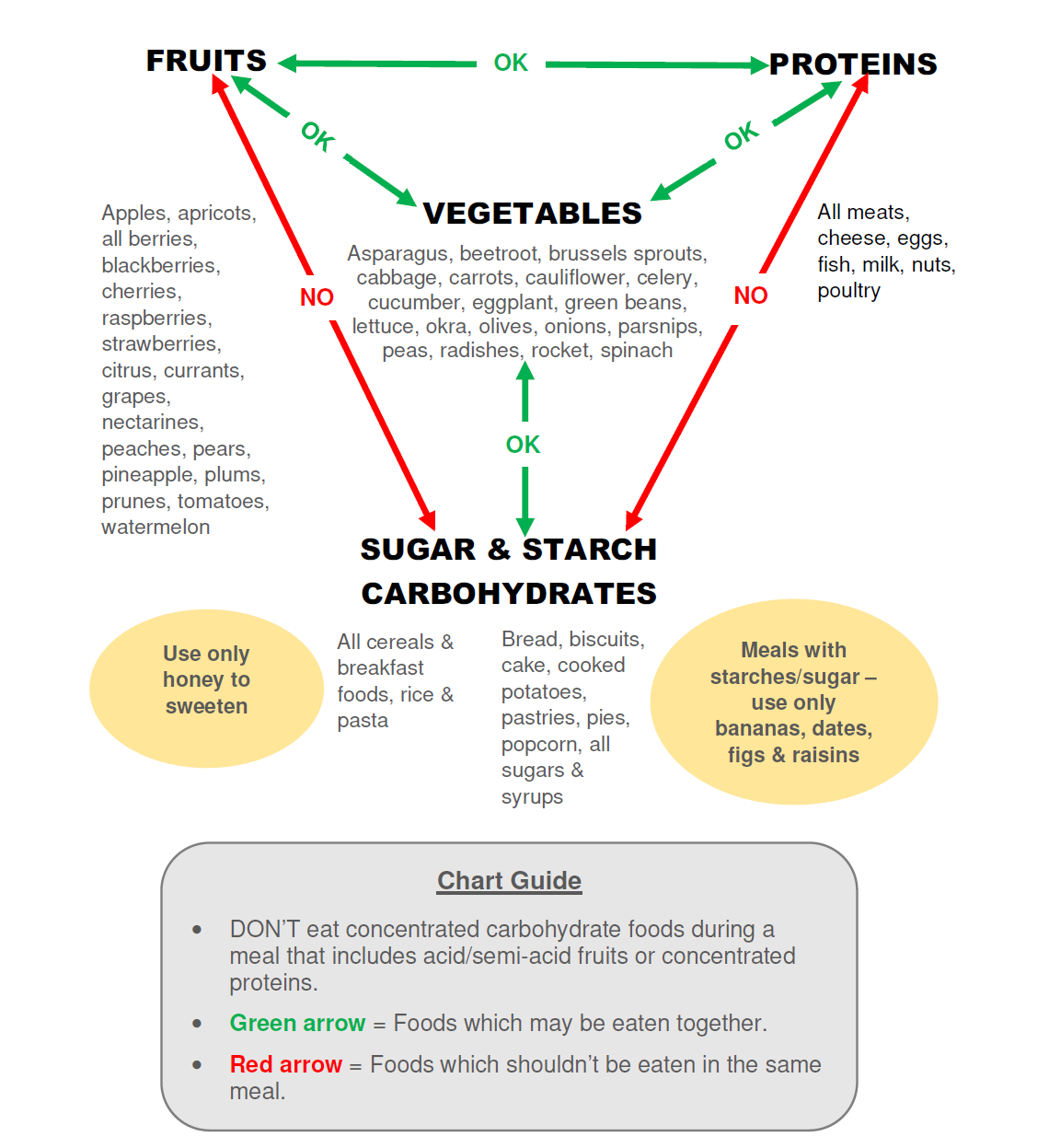
Dr Walker’s Food-Control Guide – the Basics1

Concentrated carbohydrates – examples as given above – should be eaten alone and not with fruits, vegetables or proteins. 

Fruits are the body’s cleansers and comprise between 75 to 90% water. Raw juice from all fruits contains the finest organic water available. Eaten on their own, fruits have an alkaline effect on the body. Eating fruits on their own is crucial to detoxify your system and save you money; you won’t need to buy ‘detox’ kits.

And don’t waste your time with smoothies. Pulverising incompatible fruits and grains into liquid nothingness is not nearly as good as crunching an apple.  

Concentrated starch and sugars (e.g. bread, bananas) and grains (e.g. oatmeal, cereals) eaten with fruit will ferment and turn acidic. Hence the ‘bloating and gas’ – words that advertisers love – and eventually, the distended stomach. 

To quote Dr Walker: 

‘Destructive fermentation and putrefaction in the body result from eating at the same time foods containing concentrated sugar and starch carbohydrates with concentrated proteins or with acid fruits. 

‘A chemical reaction, frequently called acidosis is likely to result.’2

Those points again:

  • Fruit (except bananas), protein and vegetables: OK together
  • Fruits are best eaten alone as they are the body’s cleansers
  • Acid-tasting fruit (e.g. lemon) in fact has an alkaline reaction in the body 
  • Melons – eat alone or leave alone: they’re very high in sugar!
  • Sugars and starch carbohydrates: eat alone
  • Proteins – e.g. meat, chicken or fish should not be eaten with starchy foods such as rice, potatoes or pasta.

Dr Walker also tells us that if we drastically reduce, and preferably completely eliminate, all cooked starches and meat, our health will significantly improve: 

‘Eating concentrated starches in excess results in inorganic calcium deposits in the cartilage of the joints … ’3

‘Eating of meat increases the body’s acidity. The processes of digestion and the breaking down of meat produces uric acid. The accumulation of uric acid acid in our system causes the pain and discomfort of rheumatism, neuritis and sciatica.’4

In my next blog, you’ll FEEL BETTER … even if you only change some of your eating habits. Read Walker’s formula … or yours?

 1 Walker, N.W. (1940/1970). Diet & Salad, adapted from ‘Food-Control Guide’, p.68. Norwalk Press: Summertown, Tennessee.

 2 Walker, p.25.

Walker, N.W. (1936/1976). Raw Vegetable Juices, p.135. Pyramid Publications: New York, New York.

 4 Walker, Diet & Salad, p.66.


Keeping a healthy colon

Your colon’s health and digestive processes can be optimised in several ways, and you can easily do this without pills, herbs or drugs. How? By eating the right foods at the right time.

I understand changing some of your cherished eating habits will not be easy at first. Habits are hard to break. I’d say our love affair with wrong foods developed as children: we were bribed with chocolate, ice-cream, cake and soda-colas – and we do the same to our kids who have become addicted like us.

There is evidence that a regime of healthy eating, if followed, will keep your metabolism pumping, your weight stable and your poo in excellent ‘shape’ even as you age. 

It’s hard at first to unlearn bad habits; focus on applying the rules, stick with it and it will soon become second nature!

Enzymes are the engine

In Dr Walker’s words: 

‘What do we prize above and beyond everything else? Our LIFE.’ 1

LIFE is one thing no scientist, chemist, inventor or any other human being has ever been able to create. Is it not intelligent and rational to consider that regeneration and replenishment of the life in your body must essentially come from the LIFE in the food we eat?

YES! That makes sense. Let me tell you what I’ve learned that many of us don’t know.

Foods in their natural raw state comprise atoms and molecules. Such active atomic life is classified as enzymes. Without enzymes, our bodies simply cannot function.

Enzymes enable us to digest food and to absorb it into our blood. In the mouth, stomach, intestines and through the entire digestive system, innumerable enzymes are involved in digesting and assimilating our food. 

However, enzymes are only present in raw foods: they are sensitive to temperatures above about 47°C, become sluggish above 49°C and completely die at 54°C.

More cooking = less enzymes = ‘dead’ food. 

As we age, our natural enzyme production decreases. I have been taking Vitalzym Extra Strength© gel capsules to maintain normal enzyme levels. But please check other brands on the market to see which is best for you. 

Food should be properly selected and most of it should be raw, uncooked and unprocessed. In this state, your body’s cells and tissues are nourished in the speediest and most efficient manner possible. Dr Walker warns that if we don’t eat the kind of food which will nourish our bodies constructively, we’ll not only die prematurely but suffer along the way. 

I am not suggesting that we stop cooking and become chomp-carrot rabbits. But you will probably say, ‘I love my food! I have one life and I’m going to enjoy it!!’  

I believe you can, not by being imprisoned by a diet foreign to your lifestyle but by being smarter in choosing what and when you eat – even if you have allergies or intolerance to foods like dairy, wheat or nuts.   

In fact, most of Dr Walker’s suggestions will suit you perfectly.  

Your one life is your only life – I don’t want you to spend what’s left of it getting repeat prescriptions of Sevikar, Lipitor, Mobic, or Mylanta.   

Getting better with Walker

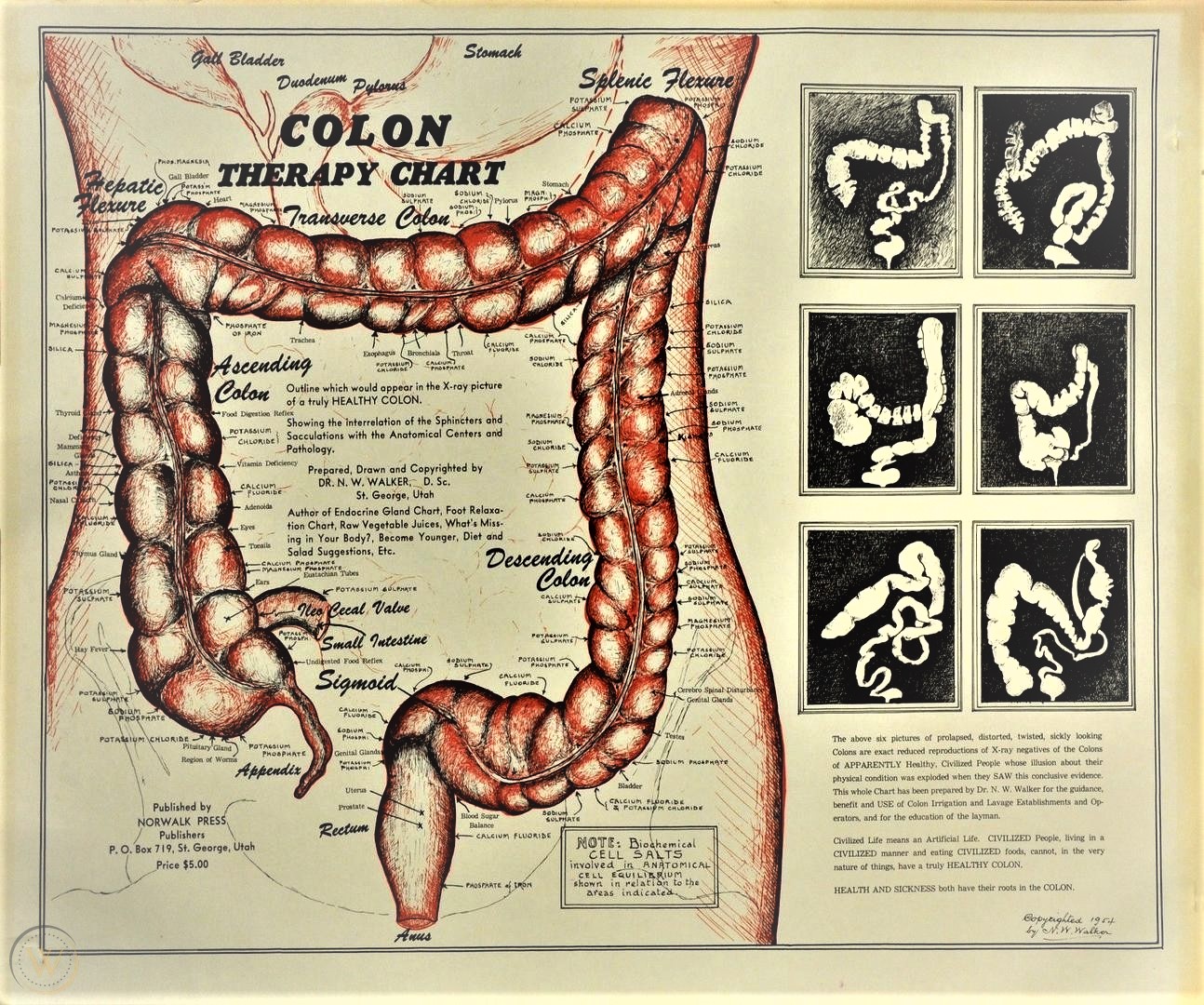
Now take a close look at Dr Walker’s colon therapy chart below:2 

You’ll see that each section of the colon relates to different parts of the body. Common ailments and deficiencies result in areas where the colon is sluggish and unable to do its job. This may be similar to reflexology principles, but it is more science-based.

Years of eating cooked, canned and processed foods have merely sustained your life – hardly any organic nourishment was eaten to regenerate the body’s cells and tissues. 

We have abused our colon, and prevented it from doing its job.

So by the time we’re 30, we find ourselves in a neglected body with perhaps a foggy mind –  all degenerating rapidly and headed for a future of prescribed drugs to ‘treat’ the diseases ailing us.  

The drugs will no doubt do their job and save your life. You’re feeling better, you take your medications religiously and all’s well again.  

But please don’t let this illusion of ‘being cured’ lull you into complacency.

All drugs have side effects. How much will vary. Eventually your medications will have to be changed to either reduce your dependence or reduce on their side-effects.

You can choose to be PROACTIVE: 

Eat more raw, organic food.

Reduce your weight.

Exercise

All can be done successfully … in my next instalment

 1 Walker, N.W. (1940/1970). Diet & Salad, p.8. Norwalk Press: Summertown, Tennessee.

 2 Walker, Diet & Salad [back cover]